How the Siirt Pistachio Differs From Other Pistachios
4 min readZaferler Kuruyemiş
Aroma, nutritional value, oil content and yield: a detailed comparison of the Siirt pistachio with the Antep pistachio and other varieties.
Türkiye is one of the countries growing the world's finest pistachios. Within that range the Siirt pistachio has become, in recent years, a product much talked about in both domestic and international markets. Its large kernel, powerful aroma, high protein value and yield advantage set it clearly apart from other popular varieties such as the Antep pistachio.
In this article we examine in detail how the Siirt pistachio differs from other varieties, compare it closely with the Antep pistachio, and look at the characteristics that make a difference from cultivation through to nutritional value.
1. General characteristics of the Siirt pistachio
The Siirt pistachio is a distinctive variety grown in south-eastern Anatolia, particularly around Siirt, Batman, Kurtalan, Baykan and Şirvan. Its most notable features:
- The kernel is large and full
- It tastes richer, although its actual oil content is lower than the Antep pistachio's
- The shell is harder and thicker, so it keeps its freshness longer
- The harvest comes later than the Antep pistachio's
- Protein, vitamin and mineral values are notably high
- In industrial use the shelling yield is very high
These qualities give the Siirt pistachio a special position for consumers and for the food industry alike.
2. Differences between the Siirt and Antep pistachio
These are the two most frequently compared pistachios in Türkiye. Both are valuable, but there are technical and sensory differences.
2.1 Kernel size and appearance
| Feature | Siirt pistachio | Antep pistachio |
|---|---|---|
| Kernel size | Larger and fuller | Smaller and slimmer |
| Colour | Light green to yellow tones | Darker green |
| Shell | Thick, hard, closed | Thinner, opens easily |
The Siirt pistachio is chosen especially by those who prefer a large kernel. In industrial production, larger kernels bring a cost advantage.
2.2 Aroma and taste
The Siirt pistachio's flavour profile:
- Intensely aromatic
- Balanced richness
- The aroma becomes more dominant when roasted
- Delivers a strong taste even with light salting
The Antep pistachio, by contrast:
- Has a more pronounced oily taste
- Carries a "sharper" aroma
- Is the traditional flavour used in desserts
The aroma of the Siirt pistachio is found far more appealing for snacking.
2.3 Nutritional comparison
Both pistachios are nutritious, but the Siirt variety stands out in several respects.
Nutritional advantages of the Siirt pistachio
- Higher protein content
- More vitamins B1, B6 and E
- Rich in iron, phosphorus and calcium
- Strong antioxidant capacity
- Effective in lowering LDL cholesterol
Nutritional profile of the Antep pistachio
- Higher calories
- Higher fat
- Rich in potassium
Broadly, the Siirt pistachio has a lower oil content and a higher vitamin and mineral profile.
2.4 Oil content and calories
This matters particularly to people on controlled diets, to athletes and to health-conscious consumers.
| Feature | Siirt pistachio | Antep pistachio |
|---|---|---|
| Oil content | Lower | Higher |
| Calories | 100 g ≈ 500 kcal | 100 g ≈ 570 kcal |
| Fibre | High | High |
Thanks to its high fibre content the Siirt pistachio satisfies quickly, and its lower oil content makes it a "lighter" choice.
3. Yield advantage and production differences
3.1 Yield per tree
Siirt pistachio trees are among the highest-yielding varieties in Türkiye.
- An average of 15–30 kg can be taken from a single tree
- At maturity, annual production is more stable
- The alternate-bearing (on-year/off-year) effect is less pronounced than in the Antep pistachio
This is why growers increasingly choose it.
3.2 Shelling yield
The Siirt pistachio:
- Gives a higher kernel yield
- Has a lower shell ratio
- Produces less waste in industrial processing
For this reason producers of Turkish delight, halva, desserts, chocolate, ice cream and pistachio paste have begun to favour it.
3.3 The growing region
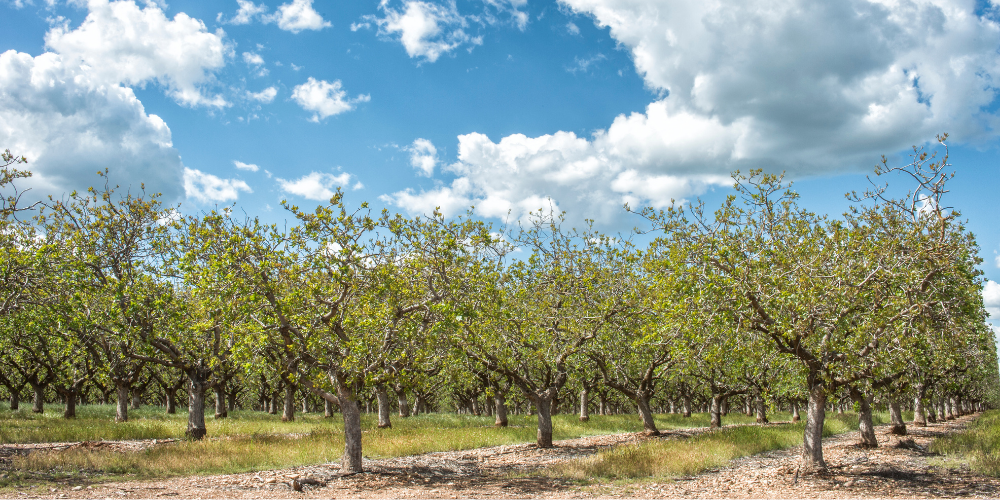
In the regions where the Siirt pistachio is grown the climate is harsher, summers are hot and winters are cold and long. These conditions give the variety its unique aroma. Plantations also use drip irrigation, modern fertilisation and rootstocks suited to the local climate.
4. Why is the Siirt pistachio increasingly preferred?
Both consumers and growers are turning to it, for several reasons:
- Larger and more striking — far more attractive when presented as a snack
- Lower fat, higher protein — an advantage for health and diet
- More vitamins and minerals — a strong nutritional source
- High yield — more economical for the grower
- Keeps its freshness longer — thanks to the thicker shell
- Versatile — suited to desserts, snacking and industrial production
5. Where is the Siirt pistachio used?
- Sold as a snack
- In the pastry sector
- Dessert production
- The Turkish delight and halva industry
- Chocolate fillings and coatings
- The ice cream sector
- Pistachio paste and pistachio cream production
Thanks to its large kernel, shelled Siirt pistachio in particular attracts strong interest from the pastry sector.
6. Conclusion: why the Siirt pistachio stands out
In taste, quality, nutritional value and production efficiency, the Siirt pistachio is a distinctive product that sets itself apart from the Antep pistachio and from other varieties. Being larger, more nutritious, more aromatic and more productive gives it a competitive position in global markets too.
Türkiye's natural setting and the climate of the region have made the Siirt pistachio not merely a nut, but a strategic product of high economic value.